Saturday, November 30, 2013

Starlight Spotlight on Chiwetel Ejiofor

Oscar Buzz for “12 Years a Slave”

Although this man needs no introduction, I will nevertheless go through the motions for the benefit of those who (gasp!!) may not know him. Chiwetel Ejiofor is a British actor of Nigerian descent. His parents fled Nigeria during the Biafran war to seek stability and safety in England and they worked very hard to give Chiwetel and his 3 siblings access to the best possible education and opportunities in their new country. In 2002 interview with The Telegraph, explained it this way,

"I am forever grateful to them," Chiwe says. "My family was incredibly worried by the nature of aggression towards people with a different skin color. They worked hard to make sure we weren't in an environment that could easily lead to us being thrown into a cruel underclass of society, something they witnessed happening all around them. They were terrified about what this country would do to their children." (The Telegraph, http://www.telegraph.co.uk). Read the entire article here.

Chiwetel has had a fantastic career in acting, scoring major roles in several blockbuster films over the years. Some of these include, “Amistad” (1997), “Kinky Boots” (2005) and one of my favorite movies in the whole world, “Love Actually” (2003). However, his most recent work in the movie, “12 Years a Slave” is being touted as the role of his lifetime. There are even strong opinions being expressed about him being a strong contender to be honored with the Academy Award for Best Actor at next year’s Oscars.

Chiwetel Ejiofor on the couch with The Queen (whom I love and adore!!) on The Queen Latifah Show.
(Video courtesy of The Queen Latifah Show and www.youtube.com)

While preparing for the role, Chiwetel took a tour through Savannah, Georgia and participated in activities like picking cotton, in order to get a better idea of some of the work that slaves did back in the 1800s. He also got to see a wall to which slaves were often chained after they came off the ships from Africa. Chiwetel connected deeply to this experience especially when he was told that Igbo slaves from Nigeria were among the groups brought into the United States through that location. Chiwetel’s family is of Igbo origin, the tribe that was also most affected during the Biafran war (hence the decision to relocate to England).

By all accounts, “12 Years a Slave” is one of the year’s best movie but this is not surprising because the movie’s director, Steve McQueen appears to have succeeded in assembling an uber-talented cast. Aside from Ejiofor, the cast also includes Brad Pitt and Alfre Woodward (whom I love and adore!!!). It is quite apparent that these actors worked very hard and cared very deeply about giving a powerful on-screen performance in order to do justice to the story and honor Solomon Northrup’s life and legacy (the movie is based on his memoir of these true life events.)


Now we have all been taught in History class that thousands of free blacks were kidnapped during that era and resold into slavery. However, it is not often that we get the opportunity to see such experiences adapted into a blockbuster movie for the edification of the general public. For this reason, special thanks go out to Steve McQueen for not allowing the multiple challenges he must have faced to stop him from making this movie. It is a story that needed to be told and told to a mainstream audience, not an Indie one (nothing against Indie audiences, please don’t send me hate mail! I love Indie films, read my blog!). So thanks Mr. McQueen, for being a voice to those who could not make themselves heard. We salute and appreciate you!

XOXO,
Starlight.


Friday, November 29, 2013

Starlight Movie Review: “Kirikou and the Sorceress” (Animation, French language)

Cuteness Quotient – High, Nipple Quotient…ahem...Very High

To say that this film has one of the cutest main characters you will ever see would be putting it very lightly. Kirikou is adorable, cute and very brave. He is the son that every mother wishes for; the film begins with him demanding to be let out of his mother’s belly and then proceeding to crawl out by himself, after which he disconnects the umbilical cord with a decisive yank. This bit of hilarity decidedly sets the tone for the entire film as Kirikou immediately takes an interest in the problems of his village and bravely goes to work trying to resolve them even at the risk of mortal peril.

“Kirikou and the Sorceress” was written and directed by Michel Ocelot in 1998. Okay, so the film is several years old, but that does not stop the magic! In fact, it only enhances is, which I guess is why it is being shown at the African Diaspora International Film Festival, 2013. I am delighted that this movie continues to be introduced to new audiences as it is entertaining both for children and for adults. I certainly enjoyed every minute of it.

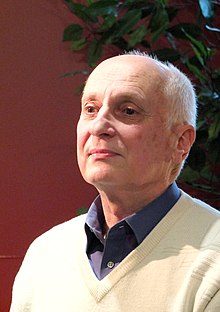
Michel Ocelot
  (Image courtesy of wikepedia.org)

Michel Ocelot is a renowned European writer, storyboard artist, character designer and director. He was born in France but spent his childhood in the West African country of Guinea before returning to his birth country during his teenage years. Now a septuagenarian (he turned 70 this year), Michel has created several highly-acclaimed animated films but “Kirikou and the Sorceress” was by far his break-out work and the one that got him world-wide fame…and a fair amount of notoriety as well. You know what they say; every rose has its thorns. This brings us to the subject of the…ahem...nipples.

“Kirikou and the Sorceress” is set in a West African village where the women (and men, but who cares about them, right?) are bare-breasted, in other words, completely nude from the waist upwards. By now, we’ve all seen video footage taken by cultural anthropologists of African and (non-African) tribes in certain parts of the world that have remained relatively untouched by Western civilization, where this is the regular mode of dressing. To people who live in this way, bare-breasts are a normal part of life and not something that arouses wild animalistic sexual urges like they do in the West. Western cultures are completely obsessed with boobs, which is why breast augmentation via plastic surgery is a 10 billion-dollar industry in the United States alone.

Here’s an excerpt from a Wikipedia article about this film which outlines the reaction of a few western countries to the abundant “northern exposure” contained in “Kirikou and the Sorceress”:

While already a household name in much of continental Europe, (…) his success in the more conservative markets of the United Kingdom, United States and Germany has been restricted by a mixed reaction to the realistic and non-sexual, but nevertheless omnipresent nudity in his breakout film Kirikou and the Sorceress. Although all of these countries' boards of film classification have approved it as being suitable for all ages, cinemas and TV channels have been reluctant to show it due to the possible backlash from offended parents.” (Kirikou and the Sorceress, Wikipedia) (Emphasis, mine).

What can one say to this other than, “Chill out people! Stop being so uptight! Your kids have seen far worse things! With all the sexual innuendo they are constantly being bombarded with on television, they probably know more about sex and the female anatomy than you do! Besides, the nudity in Kirikou and the Sorceress is far from being sexualized, it is very innocent really, just the way God intended it when Adam and Eve were in the garden. So relax!”

(Excerpt from "Kirikou and the Sorceress" courtesy of youtube.com) 

All joking aside, there are many lessons to be learnt from this film. For example, Kirikou finds out (after going on a dangerous quest to meet a wise old man), that the Sorceress (Karaba) is wicked to the villagers because she suffers from terrible personal pain herself. How often have we come across this in life, for instance, parents who hurt and damage their children because they themselves are living with the pain of hurts inflicted on them as kids? A man who does not know how to love a woman because he has never experienced love himself? Young girls who cannot love themselves because they were abused as children? Yes, a great deal of pain is often inherent in the human condition. Rather than blame the person, sometimes it might be worthwhile to look deeper and try to find the root-cause of the problem because then, we would stand a greater chance of finding a solution.

The film ends with a very surprising and unexpected twist, do not for one second assume that you know what is coming because what happens at the end is quite shocking. Okay, maybe I’m being a tad dramatic but it is a great film. Also, the soundtrack features none other than the great Senegalese African treasure: Youssou N'Dour. If this is not a reason to see this film then I don’t know what is. Though originally done in French, this film is available for viewing online with English subtitles. There might be English versions out there too. 10 stars and 10’s across the board from me. Spectacular!

Thursday, November 28, 2013

Starlight Movie Review: "Stateless" (Documentary Film)

Lies and Threats and Beheadings...and the UNHCR, Oh My!!! 

The documentary film "Stateless" is my first pick from this year’s African Diaspora International Film Festival (ADIFF). It is the latest project from Scott Erlinder, a Chicago-based filmmaker and his wife Ginger Scott-Erlinder.

(The creators of the documentary Stateless spoke April 12, 2013, at the Center for the Visual Arts after a screening of the film: Scott Erlinder, Mutuyimana Manzi, project editor Priya Yavagal, and Ginger Scott-Erlinder ’87. Courtesy of stories.illinoisstate.edu)

Now for a little background info: On different occasions during the last few years, the Office of the United Nations High Commissioner for Refugees (UNHCR) has deliberated on evoking the cessation clause which would essentially end the refugee status of Rwandans living in other countries. This has been at the behest of the Rwandan government which has been petitioning the UNHCR since 2002 to bring its citizens home. After several meetings, it was finally decided that as of June 2013, Rwandans who had left between 1959 and 1998 should return to their country of origin because the conditions of political instability and genocides which had caused them to flee were no longer in existence. 

The other side of the coin is that many refugees are unwilling to return to Rwanda due to the oppressive government now in place which uses violence and intimidation tactics to suppress opposition. This fear and unwillingness to return, combined with the cessation clause has now caused many Rwandan refugees to become “stateless”, which is where the film gets its name. Obviously, I am giving an abbreviated version of the story but the events surrounding this situation have been covered extensively in many online articles including this one.

Right now I know what you are thinking, documentaries are usually long and boring especially when they are about governments and the United Nations and dry subjects like that. Initially, I felt the same way and tried to come up with excuses not to watch this film. However, having now seen it I can tell you that your reluctance is completely unfounded, at least as relating to this particular documentary.

First and most importantly, the entire film including opening and closing credits will only take up a mere 46 minutes of your time. This is commendable. Secondly, the narration is done in a very engaging manner that is easy to understand. This combined with the footage will keep you riveted for the entire three-quarters of an hour. Thirdly, there are scenes that show beautiful streets, buildings and homes which portray a side of Africa that few in the West ever get to see. Fourthly, there are beautiful songs included in the movie soundtrack. All these make the documentary far easier to view than most, you will agree, no awkward silences and people crying in front of the camera as you might expect, considering the sad subject matter. Well that’s Africa for you; we always find a way to smile through the pain.

(Image courtesy of http://www.theeastafrican.co.ke)

But what made this film even more fascinating, is the amount of drama! You didn’t think there’d be drama involved in anything that wasn’t a reality show about housewives did you? Well, let me break down a few of the highlights:

  • Scott Erlinder could not even set foot in Rwanda. Why? Because this might have endangered his life. You see, aside from the fact that his movie is calling BS on everything the current Rwandan government has said about how awesome things have now become in the country, another family member of his, his brother Peter, is hated by the same government for the work he did on the International Criminal Tribunal on Rwanda. Read more in this article. Drama!
  • Scott made the movie by sending cameras to Rwandans and asking them to record footage and tell their own stories of the situation on ground. It was a very risky thing to do as is evidenced by the fact that one of the Rwandans who helped with gathering footage for the film (Mutuyimana Manzi, shown in the first picture above) is now living in the United States. Why? Because after his role was discovered, death threats were issued and attempts were made on his life. Scott and Ginger Erlinder then went into action and helped bring him into the US. Read more in this article. Drama!
  • The film is quite graphic at times and there are pictures of people who have suffered some violent and barbaric form of violence, including beheadings. These are things which one would have hoped were part of a bygone era in African history but sadly, nooooo. Watch the entire film here. Drama!
  • There are interviews with all sorts of credible sources, including former highly placed government officials of the current regime who are now living in exile! As the film asks, “What does that say about the Rwandan government?” There are also several accounts of people being brought up on false charges and imprisoned without trial and sometimes even murdered. The main victims here are usually members of the opposition and journalists who have written anything that is in any way critical of the government. Once again, weren't you hoping that as a continent we were past such shenanigans? Sigh. Watch the entire film here.


Sadly, this is the situation that most Rwandans are being forced to return to as a result of the UNHCR’s cessation clause. In the spirit of Thanksgiving, I am thankful among other things, for the fact that both my adopted country and my country of origin are stable and peaceful by comparison to countries like Rwanda and the Democratic Republic of Congo. We should continue to pray for Africa in general and countries like these in particular, that they will get through these trying times and one day emerge strong nations with stable democratic governments which truly protect and serve their citizens. 

Until then, thanks to films like “Stateless”, we can stay informed about the plight of those less fortunate than we are, through no fault of their own. From me, this movie get's 10 stars and 10's across the board. It can be viewed online at nyadiff.org. Watch it now.

XOXO,
Starlight.


Happy Thanksgiving!!


Tuesday, November 26, 2013

You Should Know: African Diaspora International Film Festival

(Image courtesy of www.nyadiff.org)


The African Diaspora International Film Festival (ADIFF) was started in 1993 by Reinaldo Barroso-Spech and his wife, Diarah N’Daw-Spech. 


Very passionate about education, the couple set out to create a place where films from around the world depicting the African or African diaspora experience could be premiered for the general public. The film festival lasts 18 days and provides exposure for independent films which would otherwise probably never really see the light of day.

In a very competitive industry where screenwriters and producers the world over struggle to make their voices heard through their art with hopes of maybe one day making it to the big leagues, it is unfortunate that there are precious few mainstream films that chronicle the black experience, African or otherwise. Therefore, it a great source of comfort that organizations like ADIFF are working to try and bring a little equity of subject matter to the film industry.

We are still a long way from equality of representation in every aspect (of life) but it is always nice to know that progress is being made. One of the challenges with endeavors such like this is always getting the word out. I have lived in New York for several years and I only became aware of this organization this year…what’s worse, I was informed of it by a friend who lives in Lagos. It’s amazing how information moves around in backward loops sometimes. So in writing this post, I am in turn doing my part by passing on the good word and helping to raise awareness.

(Image courtersy of www.nyadiff.org)


Let’s get into the exciting news: This year’s African Diaspora International Film Festival 2013 will be holding at various venues in Manhattan (and one venue in Queens) from 29 November 2013 to 15 December 2013. Tickets and passes that provide unlimited access to all films as well as panel discussions with directors and other stakeholders are on sale now for the modest sum of $175 which is a really great value. Tickets for individual/double features can also be purchased through the ADIFF website (you will be linked to an outside vendor before you can complete the transaction online).

In upcoming posts, I will be reviewing my top picks from ADIFF 2013. This is not an easy task as there are so many good films to choose from so stay tuned. In the meantime, do make plans to attend a screening or two and maybe I'll see you there.

XOXO,
Starlight.

You Should Know: Africans In the Diaspora (AiD)

(Image courtesy of www.africansinthediaspora.com)

Africans in the Diaspora (AiD) began with the fortuitous meeting of two women at a conference for foundations working in Africa. As they shared and discussed ideas, they discovered a shared vision namely: The desire to bridge the gap between Mother Africa and her Diaspora children and use the vast intellectual, financial and professional resources wielded by Diaspora Africans to foster development on the mother continent.

Thankfully, Solome Lemma and Zanele Sibanda did not sigh wistfully and return to their regular lives with folded arms as many of us do when we speak of social change. Instead, they rolled up their sleeves and got to work and today, that fateful meeting has given birth to the organization known as Africans in the Diaspora (AiD).

(Image courtesy of www.africansinthediaspora.com)

Though often ignored, Diaspora Africans are a very diverse and influential group of people who wield great economic power. This is why AiD is focused on harnessing these resources and using them to foster development on the African continent. For instance, visitors to the organization’s website can donate funds to community projects and nonprofits that are working to bring about positive change in the lives of Africans. They can also sign up to be included in a database of professionals who are willing to lend their know-how in various fields to people and businesses in need.

There are many other ways to get involved with AiD and the exciting work this organization is doing. Right now, in the spirit of the holidays and giving, you can get involved via the “New Year, New AiD fundraising campaign. Proceeds will benefit the following organizations:


Visit AiD’s website to learn more.

Here’s to not just talking, but also working to bring about the change we want to see.

XOXO,
Starlight.

You Should Know: Museum of the African Diaspora (MOAD)

(Image Courtesy of www.moadsf.org)

The Museum of the African Diaspora (MOAD) is a nonprofit located in downtown San Francisco. Founded in December of 2005, MOAD seeks among other things, to explore the vast influence that people of African descent have had on cultures the world over through the arts. This is further illustrated by the Museum’s mission which is to:

“(showcase) the history, art and the cultural richness that resulted from the dispersal of Africans throughout the world. By realizing our mission MoAD connects all people through our shared African heritage.( http://www.moadsf.org/about/mission.html).

(Image Courtesy of www.moadsf.org)

The Museum of the African Diaspora contains a series of permanent and travelling exhibits from national and international artists. It also runs various educational programs for the community.

For these reasons and more, MOAD is befitting as the subject of our very first blog post here on Diaspora a Vie. Keep up the good work!


For more information about MOAD’s history, exhibits or programs visit their website. Also if you are ever in the Bay Area... well, you know what to do ;) . 

XOXO, 
Starlight.