Cuteness Quotient – High, Nipple Quotient…ahem...Very High
To say that this film has one of the cutest main characters
you will ever see would be putting it very lightly. Kirikou is adorable, cute
and very brave. He is the son that every mother wishes for; the film begins
with him demanding to be let out of his mother’s belly and then proceeding to
crawl out by himself, after which he disconnects the umbilical cord with a
decisive yank. This bit of hilarity decidedly sets the tone for the entire film
as Kirikou immediately takes an interest in the problems of his village and
bravely goes to work trying to resolve them even at the risk of mortal peril.
“Kirikou and the Sorceress” was written and directed by
Michel Ocelot in 1998. Okay, so the film is several years old, but that does not
stop the magic! In fact, it only enhances is, which I guess is why it is being
shown at the African Diaspora International Film Festival, 2013. I am delighted
that this movie continues to be introduced to new audiences as it is
entertaining both for children and for adults. I certainly enjoyed every minute
of it.
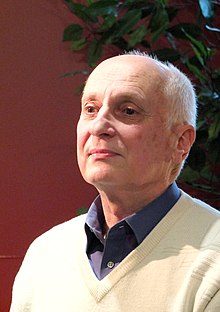
Michel Ocelot
(Image courtesy of wikepedia.org)
Michel Ocelot is a renowned European writer, storyboard
artist, character designer and director. He was born in France but spent his childhood in the West
African country of Guinea
before returning to his birth country during his teenage years. Now a septuagenarian (he turned 70 this year), Michel has
created several highly-acclaimed animated films but “Kirikou and the Sorceress”
was by far his break-out work and the one that got him world-wide fame…and a
fair amount of notoriety as well. You know what they say; every rose has its
thorns. This brings us to the subject of the…ahem...nipples.
“Kirikou and the Sorceress”
is set in a West African village where the women (and men, but who cares about
them, right?) are bare-breasted, in other words, completely nude from the waist
upwards. By now, we’ve all seen video footage taken by cultural anthropologists
of African and (non-African) tribes in certain parts of the world that have remained
relatively untouched by Western civilization, where this is the regular mode of
dressing. To people who live in this way, bare-breasts are a normal part of
life and not something that arouses wild animalistic sexual urges like they do
in the West. Western cultures are completely obsessed with boobs, which is why
breast augmentation via plastic surgery is a 10 billion-dollar industry in the United States
Here’s an excerpt from a Wikipedia article about this film which
outlines the reaction of a few western countries to the abundant “northern
exposure” contained in “Kirikou and the Sorceress”:
“While already a household name in much of continental
Europe, (…) his success in the more conservative
markets of the United Kingdom , United
States and Germany
What can one say
to this other than, “Chill out people! Stop being so uptight! Your kids have
seen far worse things! With all the sexual innuendo they are constantly being
bombarded with on television, they probably know more about sex and the female
anatomy than you do! Besides, the nudity in Kirikou and the Sorceress is far
from being sexualized, it is very innocent really, just the way God intended it
when Adam and Eve were in the garden. So relax!”
(Excerpt from "Kirikou and the Sorceress" courtesy of youtube.com)
All joking aside,
there are many lessons to be learnt from this film. For example, Kirikou finds
out (after going on a dangerous quest to meet a wise old man), that the
Sorceress (Karaba) is wicked to the villagers because she suffers from terrible
personal pain herself. How often have we come across this in life, for
instance, parents who hurt and damage their children because they themselves
are living with the pain of hurts inflicted on them as kids? A man who does not
know how to love a woman because he has never experienced love himself? Young
girls who cannot love themselves because they were abused as children? Yes, a
great deal of pain is often inherent in the human condition. Rather than blame
the person, sometimes it might be worthwhile to look deeper and try to find the
root-cause of the problem because then, we would stand a greater chance of
finding a solution.
The film ends
with a very surprising and unexpected twist, do not for one second assume that
you know what is coming because what happens at the end is quite shocking.
Okay, maybe I’m being a tad dramatic but it is a great film. Also, the
soundtrack features none other than the great Senegalese African treasure: Youssou N'Dour. If this is not a reason to see this
film then I don’t know what is. Though originally done in French, this film is
available for viewing online with English subtitles.
There might be English versions out there too. 10 stars and 10’s across the
board from me. Spectacular!

No comments:
Post a Comment